Introduction: Beyond the "Wow" Factor

AI image generation is advancing at an amazing pace, captivating a global audience with its ability to turn their text prompts into stunningly detailed visuals. Each new AI model seems to push the boundaries of what's possible, generating images that are hyper realistic, more creative, and more complex than ever before.
But the most fascinating stories aren't always found in the final, polished images. The real insights lie in the surprising, often counter-intuitive methods and philosophies that power a top-tier AI image generation model. By examining the architecture and strategy behind a model like Alibaba's Qwen-Image-2512, we can uncover deeper truths about the current state and future direction of generative AI models. It's an AI model that is not only powerful but also offers a masterclass in the core challenges and ingenious solutions that generative AI model builders face today.
1. The "Hyperrealism Trap": When More Detail Isn't Better
A common assumption in AI image generation is that more detail always equals a better image. The pursuit of finer textures, sharper lines, and richer environments seems like a logical path to follow to get hyper photorealism. However, user feedback on the powerful Qwen-Image-2512 model reveals a fascinating counter-argument: there's a point where technical prowess can cross into that "hyperrealism trap."
Qwen-Image is renowned for its ability to render incredible detail, but some users find this can lead to images that feel unrealistically detailed or plastic looking. This can create a hyper realistic effect that, paradoxically, looks less natural than images from other AI models. For instance, some users noted that while Qwen-Image-2512 adds more overall detail, they prefer the look of another models, such as ZIT, for its "excellent photorealism" in specific textures like gorilla fur, which can feel more authentic precisely because it is less granular.
This sentiment is captured perfectly in community discussions:
"imo qwen has so much detail that it becomes unrealistically detailed, kind of hyperrealistic even."
"It's like when photogs cranked HDR for a while back in the day. It piles on the clutter then cranks up micro contrast."
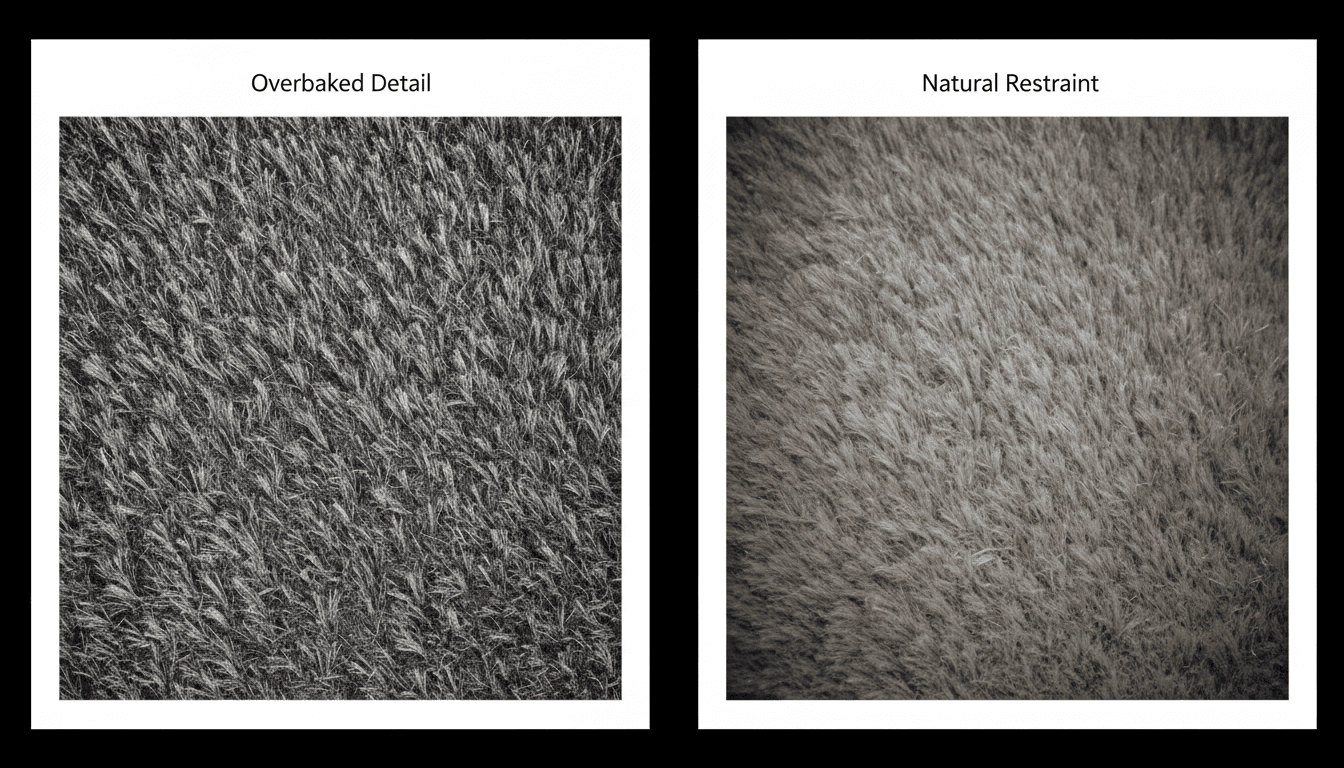
This feedback highlights a crucial tension in generative AI model space: the gap between technical capability and aesthetic taste. The goal isn't just to add more pixels of information, but to achieve a balanced, believable result that can appear overbaked or plastic looking to a discerning eye. This proves that the goal of AI image creation is not a function of maximum detail, but of masterful restraint.
2. The Secret Ingredient is Meticulous "Data Janitoring"
While cutting-edge generative AI model architectures and massive parameter counts often get the spotlight, a significant portion of Qwen-Image-2512's power comes from a less glamorous source: an immense and meticulous data curation effort. Building a state of the art (SOTA) generative AI model is less about a single stroke of genius and more about the painstaking work of data janitoring. As always, it's all about the data.
The Qwen-Image-2512 technical report details a sophisticated seven-stage data filtering pipeline. This isn't a minor cleanup; it's an industrial-scale purification process designed to progressively refine a dataset that begins with billions of raw images, making such a rigorous system an absolute necessity. The process is designed to systematically weed out low-quality, irrelevant, or problematic data. For example, the pipeline employs a variety of targeted filters to ensure only the best data makes it through:
- Clarity Filter: Discards blurry or out-of-focus images.
- Luma Filter: Excludes images that are excessively bright or dark.
- Saturation Filter: Removes images with unnaturally high color saturation that suggest artificial manipulation.
- Aesthetic Filter: Excludes images with poor composition or low visual appeal.
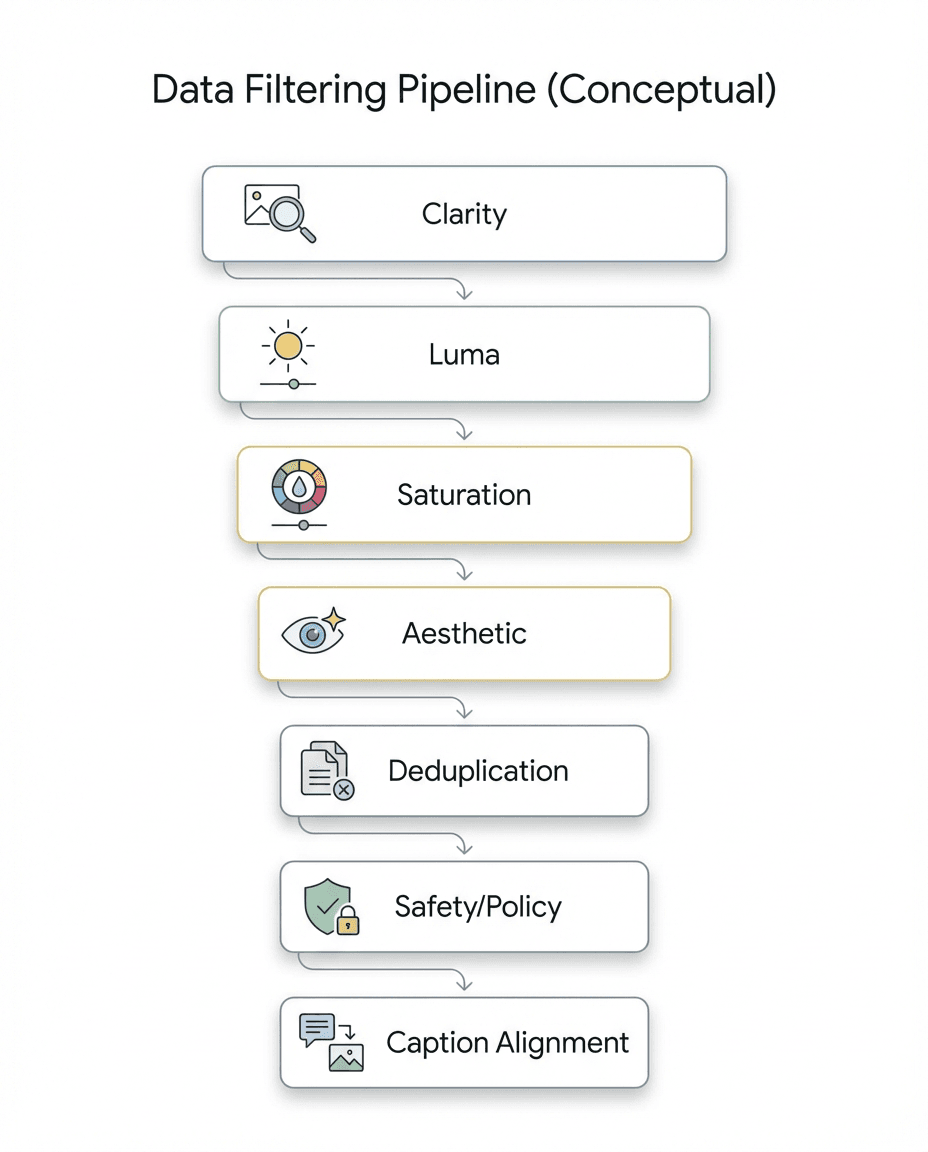
This intense focus on data quality is foundational to this AI model's success. It demonstrates that achieving superior performance isn't just about having a bigger dataset, but a cleaner one. This unglamorous, behind-the-scenes effort to filter, clean, and prepare the training data is the secret ingredient that enables the model to generate high-quality, coherent, and aesthetically pleasing results.
3. To Teach an AI to Write, You Have to Show It Synthetic Text
One of Qwen-Image-2512's most celebrated features is its advanced ability to render text accurately within images, a task where many other image generation AI models struggle. The core challenge is that textual content in real-world images follows a long tail distribution, especially for non-Latin based languages like Chinese. This means many characters appear so infrequently in photographs that a model has little opportunity to learn how to draw them correctly.
The solution is surprisingly counter-intuitive: to teach the image generation AI to render real-world text, its creators had to show it a massive amount of synthetically generated text. The Qwen-Image-2512 team developed a multi-stage data synthesis pipeline with three key strategies:
- Pure Rendering: This foundational step involves placing synthetic text from large corpora onto clean, simple backgrounds. This teaches the model the basic forms and shapes of individual characters without the distraction of a complex scene.
- Compositional Rendering: To teach context, this strategy embeds synthetic text into realistic images, making it appear as if it's written on physical objects like paper, signs, or wooden boards within a scene.
- Complex Rendering: To master sophisticated layouts, this strategy uses pre-defined templates like PowerPoint slides or UI mockups, automatically populating them with synthetic text to teach the AI model how to handle structured information, alignment, and formatting.
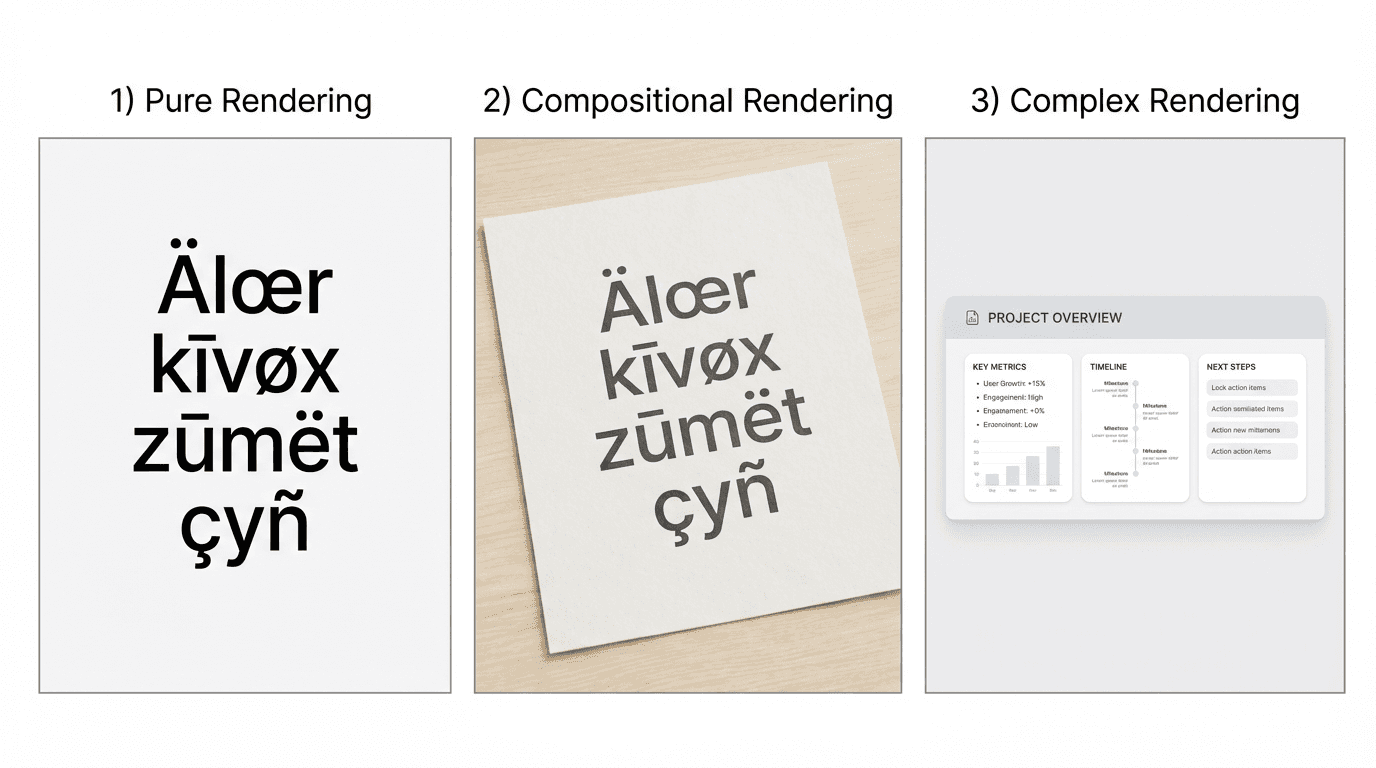
This engineered approach reveals that for an AI model to master a complex, real-world skill like text rendering, it can't rely on organic data alone. A carefully constructed synthetic dataset, designed to cover all the edge cases and rare examples, is essential for achieving true robustness and accuracy.
4. An Open-Source Underdog Is Competing with the Giants
In a field dominated by closed-source, proprietary image generation AI models from the world's largest tech companies, it's often assumed that only these giants can produce SOTA results. Qwen-Image-2512 challenges this notion by proving that a powerful, open-source generative AI model can compete at the highest level.
On AI Arena, a blind human evaluation platform where users compare images from anonymous models, Qwen-Image-2512 consistently ranks among the world's best. According to the AI Arena leaderboard, which is based on over 10,000 blind comparisons per model, Qwen-Image-2512 ranks third at the time of this writing. While it trails the leading Imagen 4 Ultra by approximately 30 Elo points, it holds a significant advantage of over 30 points against industry giants like OpenAI's GPT Image 1, cementing its position as a top-tier competitor.
Here are the top rankings from the "Text-to-Image Model AI Leaderboard":
- Imagen 4 Ultra Preview 0616 (Google)
- Seedream 3.0 (ByteDance)
- Qwen-Image-2512 (Alibaba)
- GPT Image 1 [High] (OpenAI)
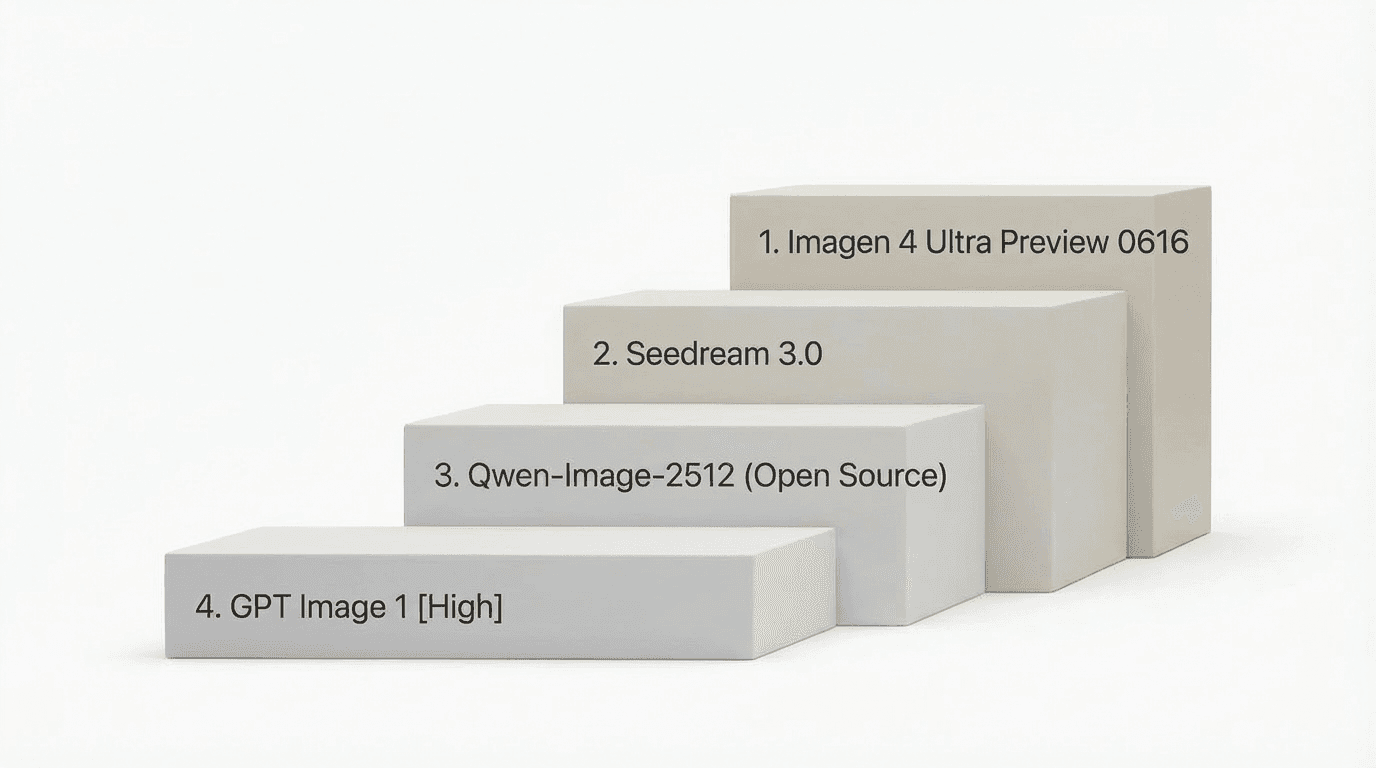
The key takeaway is clear: Qwen-Image-2512 is the only open-source model in this elite group of AI Image generation models. This is a significant achievement, demonstrating that world class generative AI model technology can be made accessible to the broader community of developers, researchers, and creators, fostering innovation.
5. The Future Isn't Flat: AI is Learning to Think in Layers
A fundamental limitation of most AI image editing tools is that they operate on raster images, which are "flat." All visual elements—foreground, background, objects, and lighting—are fused into a single canvas. This makes consistent and precise editing a major challenge; changing one element without unintentionally altering another is notoriously difficult.
A new experimental model, Qwen-Image-Layered, points to the next frontier. Inspired by professional design tools like Adobe Photoshop, this AI model is being developed to do something radically different: decompose a single, flat image into multiple, semantically distinct RGBA layers. Instead of treating an image as a single entity, it learns to see it as a composite of separate, editable parts (e.g., a person, their clothing, and the background).
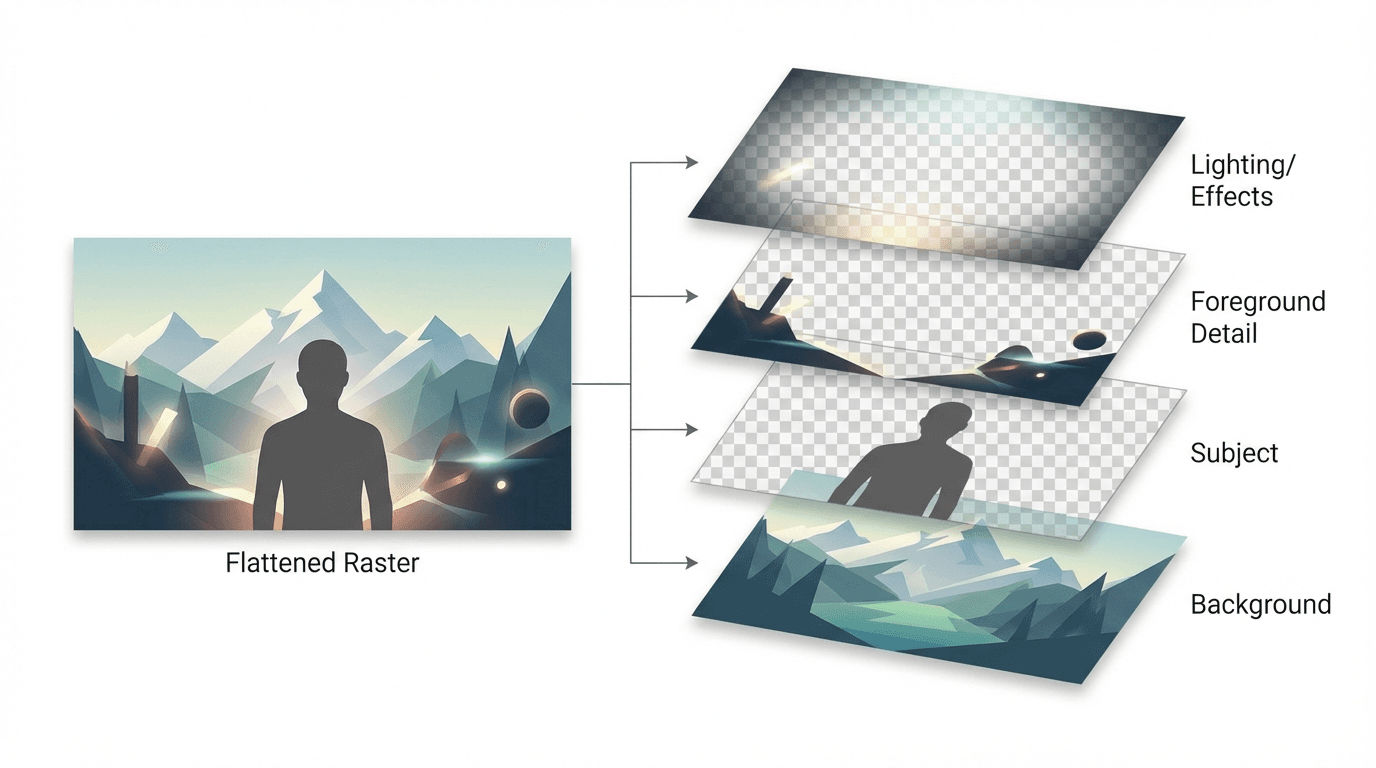
The core benefit of this approach, as stated in the research paper, is that it enables:
"...enabling inherent editability, where each RGBA layer can be independently manipulated without affecting other content."
This represents a paradigm shift for generative AI. Moving from flat images to layered, decomposable representations promises a future where creative control is no longer a clumsy approximation but a precise, intuitive, and consistent process, much like working with a professional design file.
Conclusion: From Generating Pictures to Understanding the World
Looking closely at an AI model like Qwen-Image-2512 reveals that the story of generative AI is far more nuanced than just creating pretty pictures. It's a story of complex trade-offs between technical detail and artistic taste, of immense but hidden engineering in data curation, and of innovative strategies like using a pipeline of synthetic data to master the difficult task of text rendering to overcome real-world limitations.
More profoundly, the philosophy behind Qwen-Image-2512 signals a paradigm shift from merely generating aesthetic outputs to achieving a genuine understanding of the content being created. By prioritizing capabilities like precise text rendering and exploring advanced concepts like layered image decomposition, the AI model Qwen-Image-2512 blurs the lines between visual generation and visual perception. It suggests a future where generative AI doesn't just follow instructions but comprehends the scene it is building.

As AI moves from simply creating what we ask for to truly understanding the world it depicts, what new forms of creativity and communication will it unlock?
Published on Tomorrow's Innovations | tomorrowsinnovations.co